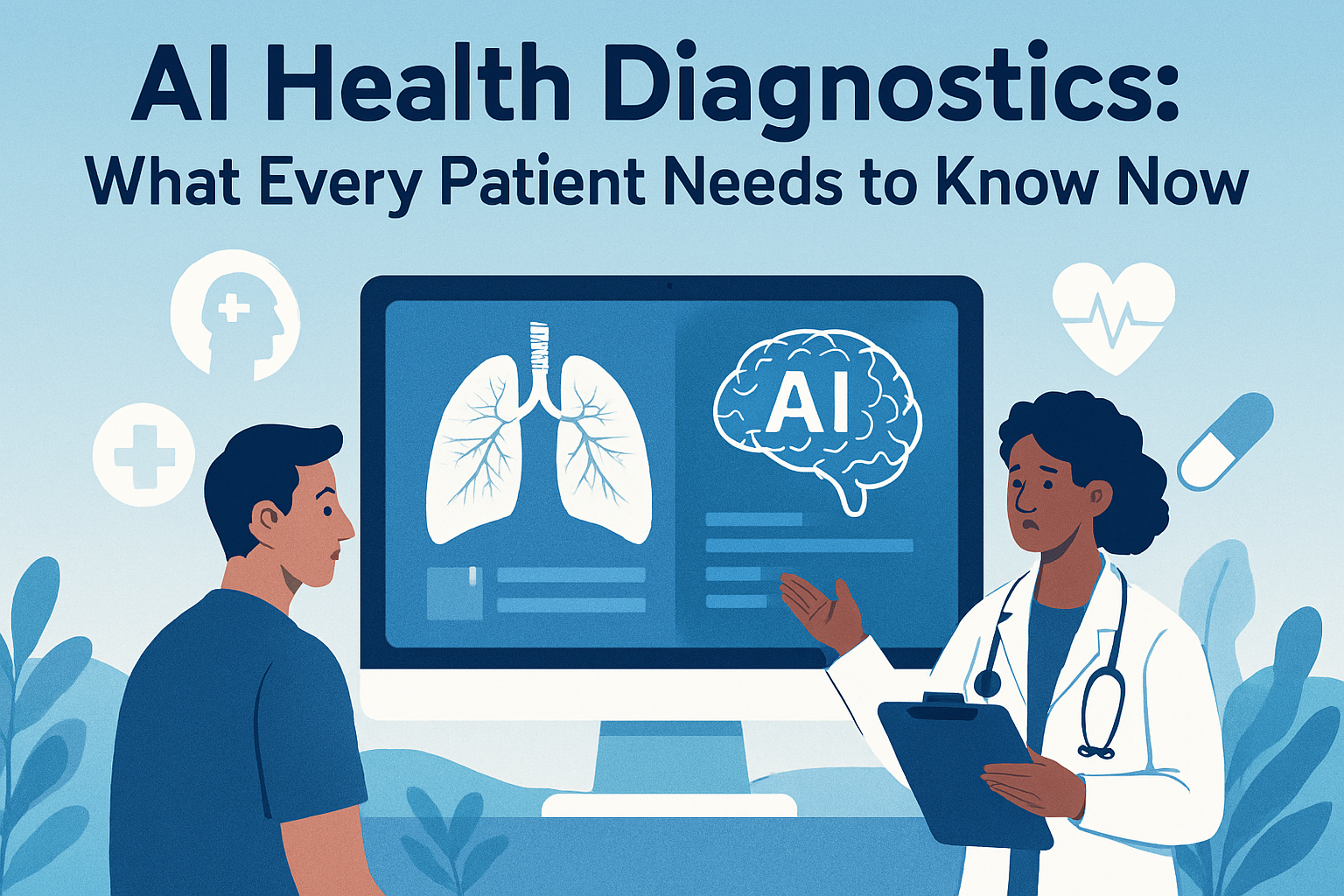
I have a confession. When my GP told me an algorithm had helped read my chest X-ray last year, my first instinct was not relief it was a quietly raised eyebrow. An algorithm? Really? But here is what shifted my thinking: the AI had flagged a subtle density in my lower right lung that, on its own, might have waited another six months in a specialist’s already-packed inbox. It did not replace the doctor. It made the doctor faster, sharper, and I will be honest probably saved me from a very unpleasant conversation down the line. That moment was my personal introduction to AI health diagnostics, and it changed the way I think about medicine entirely.
If you have landed on this page, chances are you have heard the buzz around artificial intelligence in medicine, seen the headlines about machine learning in healthcare, or maybe your doctor recently mentioned an AI tool and you found yourself nodding politely while quietly thinking, “What on earth does that actually mean for me?” You are not alone. Millions of patients are in exactly the same boat. And that is precisely why this guide exists.
This is not a press release for Silicon Valley. It is a grounded, honest, human conversation about what AI-powered medical diagnosis is, what it genuinely delivers, where it falls short, and most importantly how you, as a patient, can navigate it wisely. By the time you reach the final paragraph, you will know more about AI health diagnostics than most people in any waiting room in the country. Before AI flags an anomaly in your scan, your body often produces early warning signs your body is fighting disease that patients notice weeks before any appointment. Read our guide to the 10 signals you should never ignore.
📌 What Are AI Health Diagnostics? (Quick Definition)
AI health diagnostics is the use of artificial intelligence technologies including machine learning, deep learning, and natural language processing to analyse patient symptoms, medical images, lab results, and health records in order to detect, predict, or diagnose health conditions. These tools work alongside doctors, not instead of them, to improve both the speed and accuracy of medical decisions.SECTION 1: THE QUIET REVOLUTION ALREADY HAPPENING
The Quiet Revolution Already Happening in Your Doctor’s Office
Here is something that might surprise you: AI diagnostic tools are not some futuristic concept sitting in a laboratory waiting for approval. They are already embedded in radiology departments, pathology labs, cardiac monitoring systems, and dermatology clinics worldwide. The revolution did not announce itself with fanfare. It just… started working.
The global AI in healthcare diagnostics market was valued at approximately $2.1 billion in 2023, and analysts from Grand View Research project it will surpass $45 billion by 2030. That is not a niche trend that is a fundamental restructuring of how medicine gets delivered. And it is happening now, in your town, possibly in the hospital you last visited.
$45B AI diagnostics market by 2030 94% accuracy in AI skin cancer detection 11x faster radiology flagging vs. manual 30% reduction in diagnostic errors reported The reason this matters is deeply personal. Diagnostic delays are one of medicine’s most stubborn problems. A 2023 study published in the BMJ estimated that over 40% of patients with serious conditions experience at least one diagnostic error in their lifetime. Read that again. Forty percent. AI-assisted diagnosis is not here to steal anyone’s job it is here to close that terrifying gap.
But technology works best when you bring something to meet it. Before AI can flag an anomaly in your bloodwork or imaging, you first need to know which physical changes are worth investigating. Our complete guide to the early warning signs of disease you should know before AI can help you covers the 12 most clinically significant body signals and the 5-step framework for acting on them.
“The goal is not to replace the doctor. The goal is to give every doctor access to a second opinion that never sleeps, never gets tired, and has reviewed a million cases like yours.” Dr. Eric Topol, Scripps Research Translational Institute SECTION 2: HOW IT ACTUALLY WORKS
How AI Health Diagnostics Actually Work Without the Jargon
Let’s strip away the technical smoke and mirrors for a moment. At its heart, AI diagnostic technology is pattern recognition at an almost incomprehensible scale. Think of it like this: a seasoned radiologist might review 10,000 chest X-rays in their career. An AI model can be trained on 10 million. Overnight. That exposure creates a level of pattern-matching that complements human expertise in ways that feel almost unfair.
The Three Engines Powering AI Diagnostics
Machine learning in healthcare works by identifying statistical patterns across enormous patient datasets. Feed it a million ECG readings alongside outcomes, and it learns to predict cardiac events before symptoms appear. It is the same principle as a weather forecasting model just with higher stakes.
Deep learning medical AI goes further, using neural networks inspired by the human brain to interpret medical images with extraordinary precision. This is the technology behind AI that reads mammograms, MRI scans, retinal images, and CT results. In multiple peer-reviewed studies, deep learning models have matched or exceeded specialist-level accuracy in detecting diabetic retinopathy, early-stage lung cancer, and breast tumours.
Natural language processing in medicine is the quieter hero. It reads clinical notes, discharge summaries, patient histories, and symptoms described in everyday language then extracts meaningful diagnostic insights. Ever typed your symptoms into an online health tool and got a surprisingly useful response? That is NLP doing its quiet, diligent work.
💡 A Simple Way to Think About It Traditional diagnosis: your doctor draws on their training, experience, and the notes in front of them. AI health diagnostics: your doctor gets all of that plus a silent co-pilot who has reviewed millions of similar cases and flags anything worth a second look. The doctor still decides. The AI just makes sure nothing slips through. SECTION 3: THE REAL BENEFITS FOR PATIENTS
The Real Benefits of AI Health Diagnostics Straight Talk, No Hype
I want to be careful here. There is a lot of breathless enthusiasm in the tech press about AI in medicine, and some of it deserves serious scrutiny. But there are genuine, evidence-backed benefits that matter profoundly to real patients. Let’s look at them honestly.
1. Earlier Detection That Genuinely Saves Lives
Early disease detection AI is probably the most compelling benefit. Google’s DeepMind developed an AI system that detects over 50 eye diseases from retinal scans with accuracy matching world-leading specialists and it does so in seconds. A separate AI model from Stanford identified skin cancer with greater accuracy than board-certified dermatologists. NHS England has piloted an AI mammography tool that detected cancers missed in standard double-reading by up to 13%.
For a patient, that is not a statistic. That is a diagnosis arriving months earlier. It is the difference between Stage 1 and Stage 3. It is, in some cases, the difference between life and death. I do not say that for dramatic effect. I say it because the data says it.
2. Healthcare That Comes to You
Remote patient monitoring and AI-powered health apps are extending specialist-level insight beyond hospital walls. A farmer in rural Maharashtra and a commuter in Manchester can now access symptom-checking tools backed by the same AI diagnostic technology used in world-class hospitals. That democratisation of access is, frankly, one of the most exciting things happening in global health right now.
3. Personalised Medicine That Actually Knows You
Here is where predictive health AI gets genuinely exciting. Rather than applying a population-level average to your individual biology, personalised AI diagnostics analyse your genetic markers, lifestyle data, medical history, and even wearable health data to build a risk profile that is uniquely yours. Your Apple Watch might flag an arrhythmia. Your CGM might trigger an AI alert before you even feel unwell. This is not science fiction these tools exist today.
4. Fewer Errors, More Confidence
A 2022 meta-analysis in The Lancet Digital Health found that AI diagnostic tools reduced clinically significant errors in radiology interpretation by up to 30% when used alongside human review. Not instead of alongside. The human-AI combination consistently outperforms either alone. Remember that the next time someone frames this as a competition.
13% more cancers caught by AI mammography (NHS pilot) 50+ eye diseases detected by DeepMind AI 30% fewer radiology errors (AI + human review) 2030 AI diagnostics in most major hospitals globally SECTION 4: THE HONEST RISKS
Let’s Be Honest: The Risks and Limitations You Deserve to Know
Any guide that only tells you how great AI diagnostics are is selling something. Real authority means acknowledging the full picture. So here it is, without varnish.
AI Is a Tool. Full Stop.
AI health diagnostics cannot feel your anxiety in a consultation. It cannot notice that you hesitated before answering a question. It cannot weigh the nuance of a complicated family history against the context of your current life stress. A good clinician does all of those things and no algorithm replicates that yet. The patients who benefit most from AI diagnostics are those whose doctors use it as a tool, not a verdict.
The Bias Problem Nobody Likes Talking About
Algorithmic bias in healthcare AI is real, documented, and serious. AI models are only as good as the data they were trained on. When that data over-represents certain demographics typically white, male, younger, Western patients the model performs less reliably for everyone else. A 2019 study in Science found that a widely used commercial healthcare algorithm systematically underestimated the medical needs of Black patients. That is not a hypothetical risk. That is a documented harm that AI medical diagnosis must continue to address head-on.
⚠️ What You Can Do About It If you belong to an underrepresented group by race, gender, age, or geography it is entirely appropriate to ask your healthcare provider: ‘Has this AI tool been validated on patient populations similar to me?’ It is not an aggressive question. It is a smart one. Good clinicians will respect it. Your Data Is Part of the Transaction
AI health data privacy is a growing concern that deserves your attention. When you use a consumer AI diagnostic app, your symptoms, health history, and sometimes your genetic data are being ingested into a commercial system. Some platforms handle this responsibly under HIPAA or GDPR. Others are murkier. Before trusting any platform with your health data, ask: Is this FDA-cleared or CE-marked? Does it have a transparent, readable privacy policy? Can you delete your data on request? These are not paranoid questions they are sensible ones.
Over-Reliance Is Its Own Diagnosis
There is a specific patient behaviour emerging in GP surgeries that doctors are quietly worried about. People arrive having already self-diagnosed using an AI symptom checker, convinced of a condition, and resistant to alternative explanations. AI symptom tools are brilliant starting points. They are terrible finishing points. Use them to prepare better questions for your doctor, not to replace the conversation.
SECTION 5: WHERE AI DIAGNOSTICS ARE WORKING TODAY
Where AI Health Diagnostics Are Doing Real Work Right Now
Let’s ground this in reality. These are not pilot projects or press releases these are live, clinical applications of AI diagnostic technology that are already affecting patient outcomes.
Medical Imaging & Radiology
AI radiology diagnostics represent the most mature application of the technology. FDA-approved tools from companies like Aidoc, Zebra Medical Vision, and Aidoc are currently deployed in hundreds of hospitals. They flag critical findings pulmonary embolisms, intracranial haemorrhages, aortic dissections in real time, elevating urgent cases to the top of the radiologist’s worklist automatically. That “elevation” function alone has measurably reduced time-to-treatment for stroke patients.
Pathology & Genomics
AI-powered pathology is transforming cancer diagnosis. Systems like Paige.AI and PathAI analyse tissue biopsies and genomic sequencing data to identify cancer subtypes, mutation profiles, and treatment sensitivities with a precision that guides oncologists toward the most targeted therapies available. This is precision medicine AI doing exactly what it promises.
Mental Health The Frontier Nobody Expected
Perhaps the most surprising frontier in AI health diagnostics is mental health. Researchers at MIT, Harvard, and various NHS trusts are developing AI tools that detect early markers of depression, anxiety, and PTSD through voice pattern analysis, digital behaviour monitoring, and facial expression recognition. The technology is still maturing, and the ethical questions are considerable, but the potential to reach the millions of people who never make it to a psychiatrist’s couch is genuinely profound.
Chronic Disease & Wearables
If you own an Apple Watch, Fitbit, or continuous glucose monitor, you are already living with AI-assisted health monitoring. Apple’s ECG feature has detected previously undiagnosed atrial fibrillation in hundreds of thousands of users. The Dexcom CGM uses predictive AI to alert diabetic patients before hypoglycaemic events occur. These are not toys. They are clinically validated, FDA-cleared devices that save lives with quiet consistency.
“The most powerful thing AI diagnostics can do is give patients information before they become patients.” Dr. Hanaé Tillier, Digital Health Researcher SECTION 6: YOUR PRACTICAL PATIENT GUIDE
Your Practical Guide to Using AI Health Diagnostics Wisely
Right. This is the part where we get practical. Because all the context in the world is only useful if it changes how you actually behave. Here are five things you can start doing today.
1. Verify Before You Trust
Any AI diagnostic tool worth your trust has a regulatory stamp. In the US, look for FDA 510(k) clearance or De Novo authorisation. In Europe, CE marking under the MDR. In the UK, UKCA marking or NICE approval. If you cannot find evidence of regulatory oversight on a platform’s website within two minutes, treat it accordingly.
2. Use AI to Have Better Conversations, Not Fewer
The best use of an AI symptom tool is not to get a diagnosis. It is to walk into your GP appointment better prepared. Note what the tool flagged. Bring it as a starting point. Ask your doctor whether they agree, disagree, or want to explore further. This is what empowered patient-doctor dialogue looks like in 2026.
3. Embrace Your Digital Health Trail
Your wearable data, your app-tracked symptoms, your CGM readings this is the raw material that makes personalised AI health analysis genuinely personalised. Many patients leave this data siloed in separate apps, disconnected from their clinical record. Ask your GP practice whether they can integrate your wearable health data into your medical record. Some already can. More will. This longitudinal data is where predictive AI diagnostics become truly powerful.
4. Know Your Privacy Rights
Under GDPR in the UK and EU, and HIPAA in the US, you have the right to access your health data, request its deletion from digital platforms, and understand how it is being used. Exercise those rights. Read privacy policies (yes, actually read them, or at least the summary sections). The platforms that are transparent about data use are the ones worth trusting.
5. Ask the Questions That Matter
💬 Questions Worth Asking Your Doctor About AI Is AI being used in my imaging or lab analysis and what tool is it? | Has this AI been validated for patients with my background and profile? | Can I access any AI monitoring tools to manage my condition between appointments? | If the AI and your clinical judgment differ, how do you resolve that? AI reads the data, but someone has to collect it first. This guide covers the screening side of that equation, and you can see which at home health tests actually work before any algorithm ever touches your numbers.
SECTION 7: WHAT’S COMING NEXT
The Future of AI Health Diagnostics What’s Coming in the Next Five Years
This is the part where most articles go off the rails into speculative fantasy. I will resist that temptation. The developments below are not science fiction they are already in late-stage development or early clinical deployment. The question is not whether they are coming. The question is how quickly they will reach your postcode.
Medical Digital Twins
The concept of a medical digital twin a real-time virtual simulation of your body’s physiology, built from your personal health data is moving from research labs into clinical reality. Companies like Siemens Healthineers and Dassault Systèmes are already piloting digital twin platforms for cardiac patients. The diagnostic potential is staggering: doctors could test interventions on your virtual body before applying them to the real one.
Agentic AI in Healthcare
Agentic AI health systems AI that autonomously manages multi-step diagnostic workflows, orders follow-up tests, and coordinates care across specialists are moving from experimental to early clinical use. This is the frontier where AI health diagnostics transitions from tool to co-ordinator. The regulatory and ethical frameworks are still catching up, but the technology is ready.
Diagnostics in Your Pocket
Within five years, your smartphone will likely support FDA-cleared AI diagnostic screening for a range of conditions through camera analysis (skin lesions, eye health), audio analysis (respiratory conditions, mood disorders), and integrated biosensor data. The diagnostic gap between a city hospital and a rural village will narrow considerably. Not disappear but narrow.
FREQUENTLY ASKED QUESTIONS
Frequently Asked Questions About AI Health Diagnostics
What is the difference between AI health diagnostics and a symptom checker?
A basic symptom checker maps your described symptoms to a list of possible conditions using decision trees. AI health diagnostics goes significantly further analysing imaging, lab data, genomics, and clinical records using machine learning models trained on millions of patient cases. The depth, accuracy, and clinical integration are in a different league entirely.
Can AI diagnose cancer better than a doctor?
In specific, narrow tasks particularly image-based cancer detection AI cancer diagnostic tools have demonstrated accuracy that matches or exceeds specialist clinicians in controlled studies. But cancer diagnosis is rarely a single task. It requires clinical context, patient history, multidisciplinary input, and human judgment. AI excels at the image-reading layer. Humans excel at everything around it. The best outcomes come from both together.
Is my health data safe when using AI diagnostic tools?
Safety varies enormously by platform. Clinically deployed AI medical diagnostic systems in NHS or FDA-regulated environments operate under strict data governance. Consumer AI health apps vary considerably. Look for explicit HIPAA or GDPR compliance statements, data anonymisation policies, and the ability to request data deletion. When in doubt, ask before you input.
Will AI replace doctors?
Short answer: No. Longer answer: still no, but with nuance. AI will change what doctors do, concentrating their human expertise on the contextual, relational, and complex clinical decisions that algorithms genuinely cannot replicate. The physicians who will be most effective in the next decade are those who know how to work with AI, not those who resist it.
How do I know if an AI diagnostic tool is trustworthy?
Look for: regulatory clearance (FDA, CE, UKCA), peer-reviewed validation studies, institutional backing, transparent privacy policies, and clear statements about what the tool is and is not designed to do. Trustworthy AI health diagnostic platforms are forthright about their limitations. Be wary of any tool that isn’t.
At Last
You Are Already Living in the AI Health Era Here’s How to Make It Work for You
Let’s bring this back to where we started that chest X-ray, that flagged density, that raised eyebrow in a consulting room. AI health diagnostics did not replace my doctor that day. It made my doctor better. It made the system faster. And quietly, without drama, it made a meaningful difference to my health outcome.
That is the honest, human story of what AI-powered medical diagnosis can do at its best. It is not a cure for every problem in healthcare. It does not solve underfunding, staffing shortages, or health inequalities on its own. But it is a genuinely powerful tool in the hands of a well-trained clinician and an increasingly useful guide for an informed patient.
The three things worth carrying away from this guide are simple. First, AI health diagnostics is not a future concept it is a present reality that is already shaping the care you receive. Second, as a patient you have both the right and the capability to engage with these tools critically and confidently. Third, the human in this equation you, your body, your doctor, your relationship with your own health remains irreplaceable. AI is the co-pilot. You are still flying.
Stay curious. Ask questions. Explore the tools. And the next time someone mentions machine learning in healthcare in your consulting room, you can set the raised eyebrow aside and say, with complete confidence: “I know exactly what that means, and here is what I want to ask about this guide.”
📩 Enjoyed This Guide? If this article gave you something genuinely useful, share it with someone who is navigating healthcare decisions right now. Bookmark it for your next medical appointment. And subscribe to Medical News Blog for weekly, evidence-based insights on the technologies reshaping your health written for real people, not press releases. Related Reading on Medical News Blog
- Medical Digital Twins: Meet Your Future Virtual Self
- Benefits of Remote Patient Monitoring: 5 Key Facts
- Healthcare Innovation: Future Trends & Patient Care Strategies
- Advances in Medical Technology: Transforming Healthcare
References & Sources
1. Grand View Research (2024). AI in Healthcare Market Size Report. grandviewresearch.com
2. Singh H et al. (2023). Frequency of Diagnostic Errors in Adults. BMJ Quality & Safety.
3. De Fauw J et al. (2018). Clinically applicable deep learning for diagnosis and referral. Nature Medicine.
4. Obermeyer Z et al. (2019). Dissecting racial bias in an algorithm used to manage the health of populations. Science.
5. McKinney SM et al. (2020). International evaluation of an AI system for breast cancer screening. Nature.
6. Topol EJ (2023). The Patient Will See You Now. Basic Books / Scripps Research.
7. The Lancet Digital Health (2022). AI-assisted radiology error reduction meta-analysis. Vol. 4(11).