
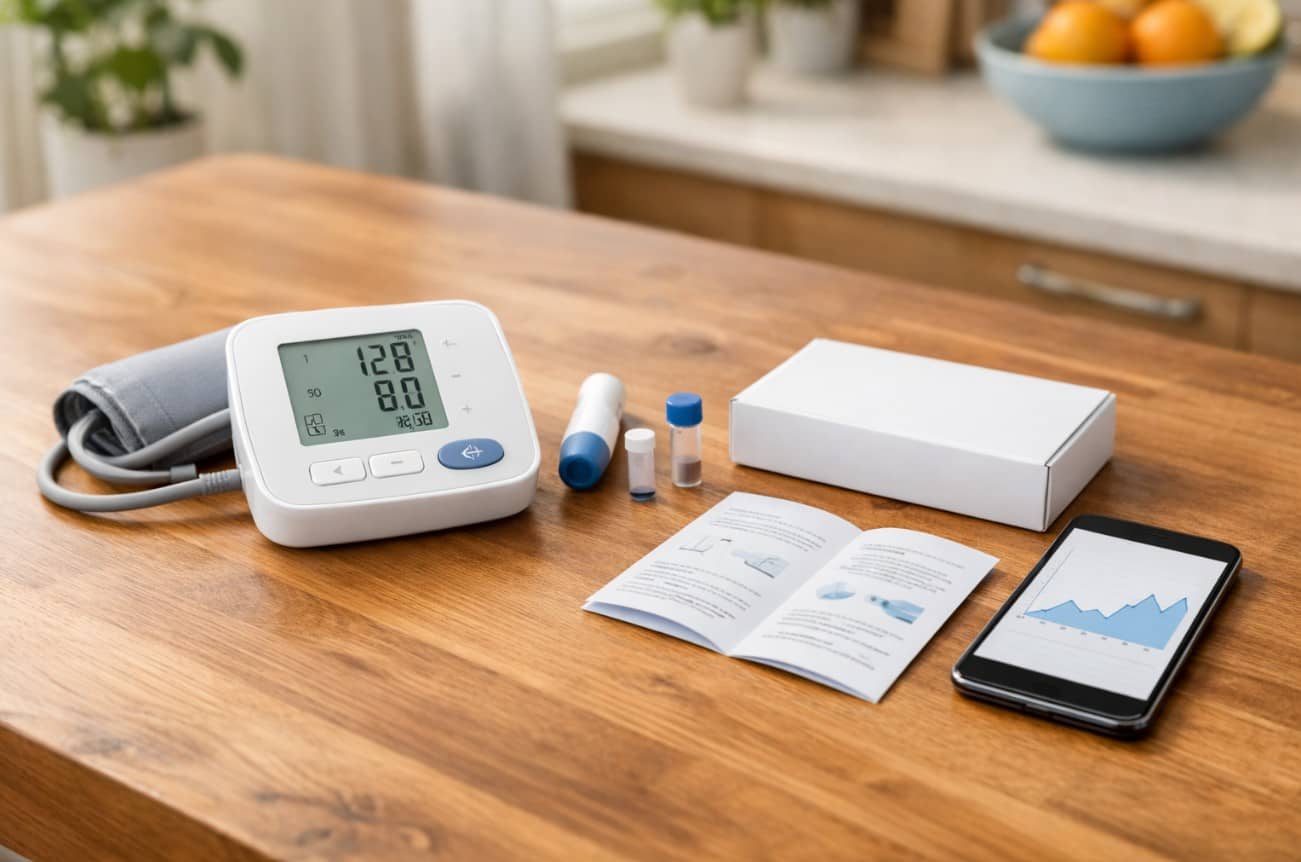
Most home test kits fail you in one of two ways. They measure the wrong thing, or they measure the right thing badly. This guide names the 9 categories of at home health tests that actually work, gives you a 4 point filter doctors use to judge any kit before you spend a rupee or a dollar on it, and tells you exactly which results you can act on alone and which ones need a clinician the same week. Read the filter once and you will never buy a gimmick kit again.
Which at home health tests actually work? Nine categories have proven clinical accuracy: blood pressure monitors, blood glucose and HbA1c kits, cholesterol panels, FIT colon cancer screening, thyroid TSH tests, vitamin D tests, STI screening kits, UTI test strips and home sleep apnea assessments. Each is regulator cleared and validated against laboratory testing.
You have seen the ads. A cheek swab that promises to decode your food sensitivities. A finger prick that claims to reveal your biological age. If your instinct says most of this is expensive guesswork, your instinct is right. But here is the part that stings. That same healthy skepticism keeps many people away from at home health tests that actually work, the small set of kits with real evidence behind them. Some of those kits catch problems years before symptoms show up.
I learned this the annoying way. A relative of mine ignored a cheap home blood pressure monitor for two years because he lumped it in with the gimmicks. His first reading, taken on a lazy Sunday, sent him to a doctor within the week. The monitor cost less than a family dinner. The delay nearly cost far more.
So this guide does two jobs. It gives you a filter that separates validated home health test kits from wellness theater. And it walks through the 9 categories that pass that filter today.
Why Most Home Test Kits Disappoint (And How to Spot the Ones That Will Not)
The two failure modes
Bad kits fail in one of two ways. The first group measures things that have no proven link to your health. Food sensitivity IgG panels sit here. So do most hair mineral analyses. The science community has flagged these for years, yet they still sell because the reports look impressive.
The second group measures real markers badly. A cholesterol strip stored in a hot delivery van can drift. A sample you collect wrong gives the lab garbage to work with. The marker is legitimate. The measurement is not.
The doctor trust filter: 4 checks before you buy
Screenshot this list. It stays useful no matter which new kit launches next year.
- Regulatory clearance. Look for FDA clearance or approval in the US, CE marking in Europe or CDSCO registration in India. No clearance, no purchase.
- Published validation. The maker should cite studies comparing kit results against standard lab testing. Real brands publish this. Gimmick brands publish testimonials.
- Certified lab processing. For mail order kits, the sample must go to a CLIA certified lab in the US or an accredited equivalent elsewhere. The kit is just a collection tool. The lab does the science.
- A clear next step. Trustworthy kits tell you what to do with an abnormal result. If the report ends with a vague wellness score and a supplement offer, walk away.
The 9 At Home Health Tests That Actually Work
Each entry below covers what the test measures, why doctors trust the category, who benefits most and the follow up rule. The follow up rule matters as much as the test itself.
1. Blood pressure monitors: the most validated home device in medicine
Nearly half of adults in the US live with high blood pressure, and a large share of them do not know it. Home monitors with an upper arm cuff have decades of validation behind them, and major cardiology bodies actively recommend home readings because clinic visits often distort results. Some people spike in front of a doctor. Others only spike at home.
Who benefits: anyone over 35, anyone with a family history of heart disease and anyone already on blood pressure medication.
Follow up rule: consistently high readings across a week go to a doctor. One odd reading after climbing stairs does not.
2. Blood glucose and HbA1c kits: from daily checks to 3 month averages
Around 38 million Americans live with diabetes and roughly 1 in 5 of them have no idea. India carries one of the largest diabetes populations on earth. Glucose meters give you a snapshot. Home HbA1c kits give you a 3 month average, which is the number doctors actually use for diagnosis and management.
Who benefits: people with prediabetes, a family history of diabetes or symptoms like constant thirst and fatigue.
Follow up rule: any HbA1c at or above the prediabetes range needs a confirmatory lab test ordered by a clinician.
3. Home cholesterol and lipid panels
High cholesterol produces zero symptoms until it produces a very big one. Mail order lipid panels that ship your sample to a certified lab track total cholesterol, LDL, HDL and triglycerides with accuracy close to a clinic draw. Instant strip tests are weaker, so favor the lab processed versions.
Who benefits: adults over 30 who have not checked lipids in two years, and anyone with heart disease in the family.
Follow up rule: an abnormal panel starts a conversation with a doctor about diet, repeat testing and risk. It never starts self medication.
4. FIT colon cancer screening kits: the strongest evidence of the lot
The fecal immunochemical test detects hidden blood in stool and catches roughly three out of four colorectal cancers in a single screening round. Screening guidance in the US now starts at age 45, and FIT is one of the officially recommended options, not a substitute for real screening. It is real screening. Colonoscopy still rules for people at high risk, but FIT gets millions of average risk people screened who would otherwise skip it.
Who benefits: every average risk adult from 45 up, done yearly.
Follow up rule: a positive FIT means a colonoscopy, full stop. Most positives turn out to be benign, but every one needs the scope.
5. Thyroid function tests
An underactive or overactive thyroid mimics half the complaints people bring to a clinic. Fatigue, weight change, mood shifts, feeling cold all the time. Home TSH kits use a finger prick sample processed in a certified lab, and TSH is the same first line marker a doctor would order.
Who benefits: women over 40, anyone with unexplained fatigue or weight change and people with autoimmune conditions in the family.
Follow up rule: an abnormal TSH needs a clinician to order the fuller panel and examine you. TSH opens the door. It does not finish the story.
6. Vitamin D testing
Low vitamin D is remarkably common, with many studies putting deficiency at one in four adults or higher, and it is worse for people who spend their days indoors. Home kits measure the same 25 hydroxyvitamin D marker labs use. This one earns its spot because the result changes behavior cheaply and safely through diet, sunlight and clinician guided supplementation.
Who benefits: office workers, older adults, people with darker skin living at higher latitudes and anyone with bone or muscle aches.
Follow up rule: discuss dosing with a doctor or pharmacist rather than guessing, because more is not better with fat soluble vitamins.
7. STI screening kits: privacy as the adoption driver
STI rates remain stubbornly high worldwide, and embarrassment keeps too many people from walking into a clinic. Home kits for HIV, chlamydia, gonorrhea and syphilis have closed much of the gap. The US authorized its first fully at home syphilis test in 2024, a sign of where regulators see this category going. Certified lab processing and clear result counseling make these kits genuinely trustworthy.
Who benefits: anyone sexually active with new or multiple partners, and anyone who simply wants certainty without a waiting room.
Follow up rule: every positive needs clinical confirmation and treatment. Home kits diagnose the need for care. They do not deliver the care.
8. UTI test strips
The humble urine dipstick has worked in clinics for generations, and the home version works the same way. Strips detect leukocytes and nitrites, the classic infection markers. For women who know the burning, urgent feeling all too well, a strip result speeds up the telehealth call and shortens the misery.
Who benefits: people with recurrent UTIs who coordinate care with a regular doctor.
Follow up rule: a positive strip plus symptoms means contacting a clinician for treatment. Fever, back pain or blood in urine means urgent care the same day.
9. Home sleep apnea assessments
Millions of people snore their way toward heart strain without a diagnosis, and sleep labs are expensive, awkward and booked out. Validated home sleep tests, prescribed and reviewed by a clinician, now handle a large share of straightforward apnea diagnoses. Screening questionnaires and wearable data can flag risk earlier still.
Who benefits: loud snorers, people who wake unrefreshed and anyone whose partner reports breathing pauses at night.
Follow up rule: this category works best with a doctor in the loop from the start, since the test itself usually requires a prescription.
When a Home Result Is Enough and When It Is Not
Here is the rule that keeps home testing safe. Screen at home, diagnose with a doctor. A home result that sits in the normal range for a condition you are simply monitoring can stay at home. A positive cancer screen, a severely abnormal reading or any result that clashes with how you actually feel goes to a clinician, and quickly.
Testing also works best when you already know which signals to watch for. Our guide to the early warning signs your body is fighting disease pairs naturally with this one, because symptoms tell you when to test and tests tell you what the symptoms mean.
And do not let a normal result talk you out of persistent symptoms. Bodies are complicated. Tests sample one moment. If something feels wrong for weeks, a doctor visit beats a second kit.
How Home Testing Fits the Future of Everyday Healthcare
Home testing is one leg of a bigger shift that this site keeps tracking. Algorithms now read scans and flag risks, a change we broke down in our AI health diagnostics guide on Medical News Blog. Connected devices stream daily vitals to care teams, and the benefits of remote patient monitoring show up most clearly for exactly the conditions home kits screen for, like hypertension and diabetes. Analysts expect the home testing market to keep growing at double digit rates through the late 2020s.
Brands will come and go. New markers will earn validation and old gimmicks will rebrand. The 4 point filter above outlives all of it, which is the whole reason to learn the filter instead of memorizing a brand list.
Frequently Asked Questions
Are at home health tests as accurate as lab tests?
The validated categories come close, and mail order kits processed in certified labs use the same machines a hospital sample would meet. Accuracy drops when you collect the sample wrong, so follow the instructions exactly.
Which home health test should I start with?
A blood pressure monitor, for most adults. It is cheap, validated for decades and targets the most common silent condition on the planet.
Do doctors accept home test results?
Doctors treat certified lab processed results as a strong starting point and usually confirm abnormal findings with their own testing. They treat home readings like blood pressure logs as genuinely valuable data.
How often should I use home health tests?
Match the test to its cycle. Blood pressure weekly if elevated, FIT yearly from 45, HbA1c every three to six months if prediabetic, lipids every one to two years. More frequent testing rarely adds information.
Can home tests replace an annual checkup?
No, and any kit that claims otherwise fails the trust filter. A checkup includes examination, history and judgment that no kit reproduces. Home testing fills the gaps between visits. It does not replace the visits.
Are home test kits worth the money?
The nine categories here are, because each one either catches a dangerous silent condition or saves a clinic trip. Kits outside validated categories mostly buy you a colorful PDF.
Conclusion
You do not need to trust the wellness industry. You need a filter. Regulatory clearance, published validation, certified lab processing and a clear next step separate at home health tests that actually work from the rest of the shelf. Start with the category that matches your age and family history, keep your doctor in the loop for anything abnormal and let the gimmicks keep their glossy ads. Your health decisions get sharper the moment your information does.
This article shares general health information and is not medical advice. Talk to your doctor about any test result or symptom that concerns you.