
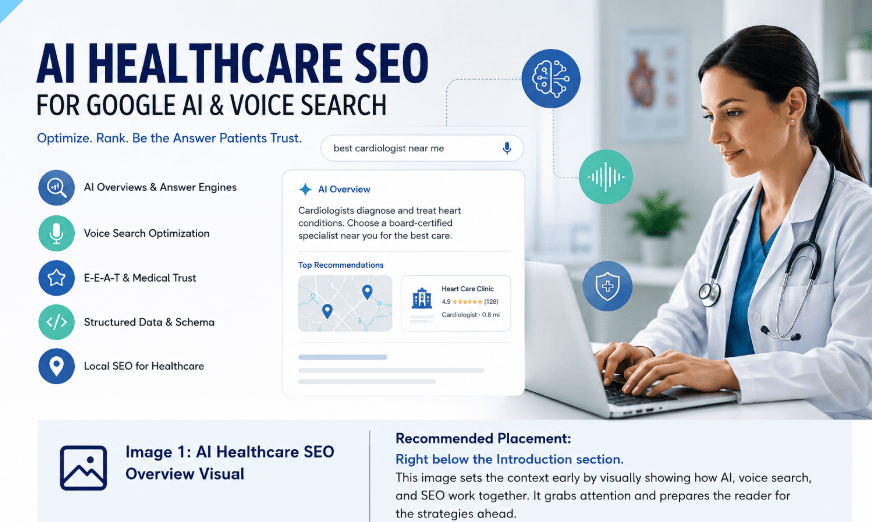
A patient asks Alexa about chest pain at 2 AM. Google answers before your website even appears.
That’s how healthcare search works now.
People no longer type short keywords into Google all day. They ask full questions through voice assistants, AI chat tools, and mobile devices. Search engines now generate direct answers instead of showing only blue links.
And healthcare websites feel this shift faster than most industries.
If your content lacks trust, clarity, and authority, AI systems ignore it. Patients never see it. Competitors take your place quietly.
I noticed this while reviewing several clinic websites earlier this year. Some had excellent doctors but weak visibility. Their articles repeated keywords endlessly without helping readers. Meanwhile, smaller healthcare websites earned traffic steadily because they explained medical topics clearly and simply.
That matters now.
Modern AI Healthcare SEO depends on trust, helpful content, and conversational search optimization.
What Is AI Healthcare SEO?
AI Healthcare SEO improves healthcare websites for traditional search engines, AI powered search tools, voice assistants, and Google AI Overviews.
Traditional SEO focused heavily on rankings.
Today, AI systems evaluate:
- Medical accuracy
- Topic authority
- Content clarity
- Expert credibility
- User experience
- Structured data
- Conversational relevance
Healthcare websites must become trusted answer sources instead of keyword libraries.
And yes, Google notices the difference quickly.
Why Most Healthcare Websites Lose Rankings
Many healthcare websites still follow outdated SEO methods.
You probably see this often:
- Thin blog posts
- Generic AI text
- Repeated keywords
- No medical review
- Poor mobile speed
- Weak internal links
Patients leave these pages quickly because they feel empty.
Google notices that behavior.
I recently opened a migraine treatment article that repeated “migraine relief” constantly but never explained actual symptoms clearly. Reading it felt exhausting after thirty seconds.
Helpful content performs better because readers stay longer.
That improves medical search optimization naturally.
Why Google AI Overviews Changed Healthcare Search
Google introduced AI Overviews because users want immediate answers.
Healthcare searches trigger these AI summaries often because medical questions usually require quick explanations.
Examples include:
- “Why does my chest hurt?”
- “Best foods for diabetes”
- “How long does flu symptoms last?”
Google now combines information from trusted websites into AI generated summaries.
Healthcare websites that publish clear, authoritative content earn visibility inside these summaries more often.
Here’s where things become interesting for healthcare brands.
AI systems now influence patient trust before visitors even click your website.
Core Ranking Factors for AI Healthcare SEO
Build Topic Authority
Google trusts websites that cover subjects deeply.
Instead of publishing random medical articles, build connected topic clusters.
Example:
Main Topic
Diabetes Management
Supporting Content
- Early diabetes symptoms
- Foods that lower blood sugar
- Diabetes exercise plans
- Insulin treatment guide
- Diabetes complications
This structure helps AI systems understand your expertise faster.
Strengthen E-E-A-T Signals
Healthcare content falls under Google’s YMYL standards.
Trust matters heavily here.
Add:
- Expert author bios
- Medical reviewer credentials
- Scientific references
- Updated publishing dates
- Clinic certifications
Patients trust verified expertise. AI systems follow the same pattern.
Use Conversational Language
Voice search changed search behavior completely.
People ask:
“Why do I feel dizzy after waking up?”
Not:
“Morning dizziness causes.”
Your content should answer natural spoken questions clearly.
That improves healthcare voice search SEO directly.
How Voice Search Changes Healthcare SEO
Voice search keeps growing because people want quick answers.
Some medical searches also feel uncomfortable to type publicly. Voice feels easier and more private.
That changes keyword strategy.
Use Question Based Headlines
Examples:
- What Causes High Blood Pressure in Young Adults?
- How Do You Treat Seasonal Allergies Naturally?
- When Should You Visit a Cardiologist?
AI systems understand these formats easily.
Add FAQ Sections
Voice assistants prefer short and direct answers.
Example:
What helps reduce anxiety naturally?
Exercise, proper sleep, therapy, and breathing exercises help many people manage anxiety symptoms naturally.
Simple answers perform better in voice search.
Optimize Local Searches
People often ask:
- “Best dentist near me”
- “Heart specialist open today”
- “24 hour pharmacy nearby”
Local SEO now overlaps heavily with voice search optimization.
Why Structured Data Matters
Structured data helps AI systems understand healthcare content correctly.
Without schema markup, AI tools struggle to identify:
- Treatments
- Doctors
- Medical conditions
- FAQs
- Reviews
- Locations
Use:
- MedicalWebPage Schema
- FAQ Schema
- Organization Schema
- Speakable Schema
This strengthens Answer Engine Optimization for healthcare websites.
How to Create Healthcare Content AI Systems Trust
Write for Humans First
Many healthcare websites chase algorithms and ignore readers.
That approach fails now.
Patients want simple explanations. Not robotic medical jargon.
Instead of:
“Hypertension manifests due to vascular resistance.”
Say:
“High blood pressure happens when blood pushes too hard against artery walls.”
Clear writing builds trust faster.
Use Real Examples
Specific examples make healthcare content feel human.
I once read a sleep apnea guide describing someone falling asleep during meetings and struggling to stay awake while driving home. That image stayed in my mind instantly.
Readers remember relatable details.
Update Content Regularly
Healthcare information changes constantly.
Update:
- Statistics
- Research findings
- Treatment guidelines
- AI search trends
Fresh content earns more trust and visibility.
Final Thoughts
Healthcare SEO no longer depends only on rankings.
Trust matters more.
Clarity matters more.
Authority matters more.
AI systems now decide which healthcare websites deserve visibility before users even open search results.
That creates a huge opportunity for healthcare brands willing to publish accurate, useful, human focused content consistently.
Focus on helping patients understand medical topics clearly.
Build topical authority carefully.
Use conversational language naturally.
Improve your technical SEO foundation.
And publish content people genuinely want to read.